 |
|
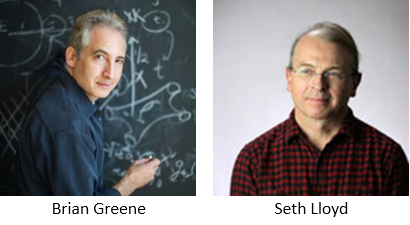
Brian Greene and Seth Lloyd “Quantum Computing: Hype vs. Reality” MEETING DATE: Thursday, December 11, 2025 6:45PM - 8:45PM (Zoom meeting room opens at 6:45 PM; Meeting starts at 7 PM) via Zoom virtual meeting. |
| |
|
Brian Greene and Seth Lloyd “Quantum Computing: Hype vs. Reality” MEETING DATE: Thursday, December 11, 2025 6:45PM - 8:45PM (Zoom meeting room opens at 6:45 PM; Meeting starts at 7 PM) via Zoom virtual meeting. |
Are quantum computers the game-changer they're described to be, or is the promise of exponential speedup overblown? Join pioneer Seth Lloyd and Brian Greene as they discuss how the fundamental principles of quantum mechanics are leveraged by quantum computers, and the algorithmic challenges in achieving the promised exponential power. This program is part of the Big Ideas series, supported by the John Templeton Foundation.
Brian Greene
Brian Greene, professor of physics and mathematics, is renowned for his groundbreaking discoveries in superstring theory, including the co-discovery of mirror symmetry and of spatial topology change. He is known to the public through his books, The Elegant Universe, The Fabric of the Cosmos, and The Hidden Reality, which have collectively spent 65 weeks on the New York Times bestseller list and sold more than 2 million copies worldwide. The Washington Post called him "the single best explainer of abstruse concepts in the world today." Professor Greene hosted two Peabody and Emmy Award winning NOVA miniseries based on his books and is a frequent television guest, joining Stephen Colbert seven times and playing himself in an episode of The Big Bang Theory. He has also had cameo roles in a number of Hollywood films including Frequency, Maze and The Last Mimzy. With producer Tracy Day, Greene co-founded the World Science Festival and he is the Director of Columbia University’s Center for Theoretical Physics.
Seth Lloyd
Seth Lloyd is professor of mechanical engineering at MIT and co-founder of Turing Quantum. Dr. Lloyd’s research focuses on problems on information and complexity in the universe. He was the first person to develop a realizable model for quantum computation and is working with a variety of groups to construct and operate quantum computers and quantum communication systems. Dr. Lloyd has worked to establish fundamental physical limits to precision measurement and to develop algorithms for quantum computers for pattern recognition and machine learning. Dr. Lloyd’s work on complex systems currently focuses transitions between stability and instability in complex dynamical systems. He is author of over two hundred scientific papers, and of ’Programming the Universe,’ (Knopf, 2004).
The video of this presentation "Quantum Computing Hype vs Reality" is available on YouTube at https://youtu.be/-1PsQIciMEc?si=MWbXW4m1m0Od7cVB